Bulgaria is a sunny, mountainous country in Southeastern Europe on the Black Sea, known for being one of Europe’s oldest nations (founded 681 AD). Located on the Balkan Peninsula, its capital is Sofia.
Bulgaria is world-renowned as the top producer of high-quality rose oil (liquid gold) and for its aromatic Rose Valley. It is famous for a rich, ancient history, boasting 9 UNESCO World Heritage sites, including the Rila Monastery and Thracian tombs.
Bulgaria is generally considered a very safe, affordable, and welcoming country for working and settling, offering a high quality of life within the EU, particularly in major cities like Sofia and Plovdiv. It has a low rate of violent crime, though petty theft (pickpocketing) occurs in tourist areas and transit hubs.
1. Extremely Affordable: As one of the most budget-friendly countries in the EU, Bulgaria offers low-cost accommodation, food, and transport, making it ideal for budget travelers and expats.
2. Stunning Natural Scenery: Roughly 30% of the country is covered in mountains (Rila, Pirin, Rhodopes), offering breathtaking hiking, skiing, and nature trails.
3. Beautiful Beaches on the Black Sea: Bulgaria boasts sandy, sun-drenched beaches, with popular, budget-friendly spots like Sunny Beach.
4. Rich History & Ancient Cities: Featuring one of the world’s oldest inhabited cities, Plovdiv, and rich Roman, Thracian, and Byzantine ruins.
5. Ideal Four-Season Climate: Experience snowy winters in ski resorts like Bansko and hot, sunny summers perfect for beach trips.
6. Thermal Spa Capital: Bulgaria has over 225 mineral and thermal springs, offering world-class spa and wellness tourism.
7. Delicious Cuisine & Wine: Known for fresh, yogurt-based dishes,, grilled meats, and a long tradition of winemaking.
8. Unique Cultural Heritage: Famous for the Rose Valley, traditional folklore, and the unique UNESCO-listed Rila Monastery.
9. Vibrant Cities & Safe Atmosphere: The capital, Sofia, offers a mix of modern, communist-era, and ancient architecture, along with a safe, bustling, and welcoming environment.
10. Convenient Location & Infrastructure: As a member of the EU (and partially in the Schengen area), it is easy to travel around, with growing digital nomad hubs and coworking spaces in cities like Sofia and Bansko.
1. Schengen Access: Immediate access to the Schengen Zone for travel, with Bulgaria being a member.
2. Low Taxation: Access to Bulgaria’s 10% flat tax rate for both personal and corporate income, one of the lowest in the EU.
3. No Physical Presence Requirement: Certain investment-based residency programs do not require a minimum physical stay to maintain the status.
4. Pathway to Citizenship: Eligibility to apply for Bulgarian (and thus EU) citizenship after 5 years of permanent residence.
5. Family Inclusion: Spouses, dependent children, and sometimes parents can be included in the residency application.
6. Rights & Freedoms: The right to live, work, and study in Bulgaria, with access to public education and high-quality healthcare similar to citizens.
7. No Language Requirement: For certain permanent residency routes (such as investment), there is no Bulgarian language requirement.
Non-EU citizens relocating to Bulgaria must generally obtain a Type D visa (long-stay) from their home country before applying for a residence permit (valid up to 1 year) through the Migration Directorate. Popular pathways include business registration (trade representative office), employment, or retirement.
1. Application Form: Completed application form for a residence permit.
2. Valid Passport: Original and copies of a passport, usually valid for at least 18 months beyond the application date.
3. Long-stay (Type D) Visa: Required for non-EU citizens, including the entry stamp.
4. Proof of Accommodation: A rental agreement (contract) or a notary-certified declaration from the owner, along with a deed if you own the property.
5. Financial Means: Bank statement proving sufficient funds to support yourself (minimum of 6 monthly Bulgarian salaries, which as of Jan 2025 is \(1040\text{\ BGN}\)/month).
6. Health Insurance: Valid insurance covering the territory of Bulgaria for the duration of stay, with a minimum coverage of \(\text{€}30,000\).Criminal Record Certificate: A “no-criminal-record” certificate issued by your home country, usually needing an apostille.
7. Criminal Record Certificate: A “no-criminal-record” certificate issued by your home country, usually needing an apostille.
8. Application Fees: A receipt confirming payment of the state administrative fee.
Bulgaria primarily offers three main types of visas based on the duration and purpose of stay:
1. Type A (Airport Transit): Allows transit through the international area of a Bulgarian airport.
2. Type C (Short-Stay Visa): Valid for up to 90 days within a 180-day period. Covers tourism, private visits, business, medical treatment, and cultural/sports events.
3. Type D (Long-Stay Visa): Required for stays longer than 90 days, including work permits, student visas, and residency for property owners.
Working in Bulgaria is generally considered good, particularly due to its low cost of living, 10% flat income tax rate, and growing sectors like IT and outsourcing. While the average gross salary is around €1,230, wages are significantly higher in Sofia (€1,732+). It offers a strong work-life balance, but, in some cases, infrastructure and bureaucracy can be challenging.
1. Sector Highlights & Demand: The IT, Business Process Outsourcing (BPO/SSC), and manufacturing sectors (automotive, electronics) remain the primary drivers of employment. There is high demand for multilingual specialists, AI/Data Science experts, and cybersecurity professionals.
2. Shifting Hiring Strategy: Companies are moving away from mass recruitment, especially for junior roles, preferring experienced specialists and automation.
3. Salary and Benefits: While 90% of employers raised salaries in 2025, growth has moderated compared to previous years. To stay competitive, companies are focusing on increased benefits, remote work options, and employee retention.
4. Demographic Challenges: A rapidly aging population and labor shortage are significant, with the 15–64 age group expected to shrink significantly by 2060.
5. Regional Differences: Significant inequalities exist, with higher employment and salary levels concentrated in Sofia and other major economic centers.
6. Future Skills: The workforce is trending toward higher qualifications, with, for example, 38% of the labor force projected to have high-level qualifications by 2035.
1. Software Developers & Programmers (Python, Java, .NET)
2. DevOps Engineers
3. Cybersecurity Experts
4. AI & Machine Learning Specialists
5. Data Scientists & Analysts
6. QA Engineers
7. IT Support Specialists
8. Database Specialists
9. IT Managers
10. Cloud Computing Engineers
11. UI/UX Designers
12. Blockchain Developers
13. ERP/CRM Consultants
14. Business Intelligence Analysts
15. Mechanical Engineers
16. Electrical Engineers
17. Civil Engineers
18. CNC Machinists/Operators
19. Industrial Welders
20. Factory Workers/Production Line Staff
21. Quality Checkers
22. Tool and Die Makers
23. Automation Technicians
24. Maintenance Technicians
25. Lathe Operators
26. General Construction Workers
27. Electricians
28. Plumbers
29. Masons/Bricklayers
30. Steel Fixers
31. Machine Operators (Heavy Machinery)
32. Road Construction Workers
33. HVAC Technicians
34. Architects
35. Truck Drivers (Long-haul/International)
36. Warehouse Workers/Packers
37. Forklift Operators
38. Logistics Planners/Coordinators
39. Sales Representatives (Multilingual)
40. Account Managers
41. Business Development Representatives
42. Delivery Workers/Couriers
43. Nurses
44. Doctors/Physicians
45. Caregivers/Personal Assistants
46. Medical Laboratory Technicians
47. Pharmacists
48. Dental Assistants
49. Chefs/Cooks
50. Waiters/Bartenders
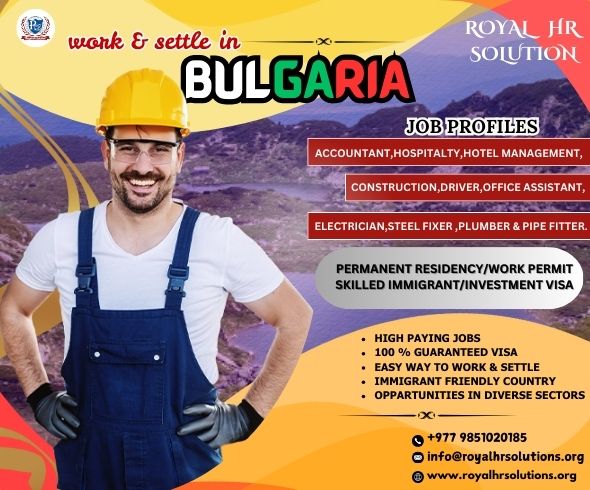
Contact us for work & settle in Bulgaria.
can help – fill in your details and we’ll call you back.