Australia, officially the Commonwealth of Australia, is a sovereign country comprising the mainland of the Australian continent, the island of Tasmania, and numerous smaller islands. As the world’s sixth-largest country and only nation governing an entire continent, it is known for its diverse landscapes—ranging from arid outback to tropical rainforests—and a highly developed, multicultural society.
Australia is world-famous for its unique wildlife (kangaroos, koalas), stunning natural wonders like the Great Barrier Reef, and iconic landmarks including the Sydney Opera House. It is renowned for its laid-back coastal lifestyle, surfing culture, vast Outback deserts, and vibrant, multicultural cities such as Sydney and Melbourne.
Australia is widely regarded as an excellent destination for working and settling, offering a high quality of life, strong economy, and multicultural society. Australia is considered a very safe, stable, and welcoming country for tourists, students, and residents, consistently ranking among the top 20 safest countries in the world. While violent crime is low, visitors should take normal precautions against petty theft in cities and be aware of natural hazards like strong sun, rips at beaches, and dangerous animals.
1. High Standard of Living: Australia is consistently ranked among the top countries for quality of life, featuring excellent infrastructure, low pollution, and safe, clean environments.
2. Strong Economy & Job Opportunities: A robust economy with low unemployment rates creates abundant opportunities for skilled professionals, particularly in sectors like healthcare, IT, and engineering.
3. World-Class Healthcare (Medicare): Residents have access to a, comprehensive, and largely free or heavily subsidized public healthcare system, known as Medicare.
4. Top-Tier Education System: Australia is renowned for its world-class education institutions, with free or affordable schooling options and high-quality universities for residents.
5. Multicultural & Welcoming Society: As a diverse nation with a high percentage of foreign-born residents, Australia offers an inclusive atmosphere, vibrant cultural festivals, and diverse cuisine.
6. Unbeatable Work-Life Balance: Australia emphasizes a healthy lifestyle, typically featuring shorter working hours and ample leisure time to enjoy outdoor activities.
7. Stunning Natural Beauty & Climate: Residents enjoy a fantastic climate with, generally mild, sunny weather and access to incredible beaches, parks, and unique, diverse wildlife.
8. Safety & Security: Australia is known for its low crime rates and high levels of personal safety, making it an ideal place for families.
9. Clear Immigration Pathways: The government offers structured, transparent visa pathways for skilled workers, students, and families looking to migrate permanently.
10. High Wages & Financial Stability: Alongside a strong currency, Australia offers high salaries and a stable economic environment, ensuring a comfortable, secure future.
Key General Eligibility Criteria (Skilled Migration)
1. Age: Under 45 years of age at the time of invitation.
2. Occupation: Must be listed on the relevant Skilled Occupation List (MLTSSL, STSOL, or ROL).
3. Skills Assessment: A positive skills assessment from the relevant authority for your occupation is required.
4. English Language: Competent English (e.g., IELTS 6.0+ or PTE 50+ in all components) is mandatory, though higher scores gain more points.
5. Points Test: Minimum of 65 points required based on age, English, experience, and education.
6. Health and Character: Must pass health examinations and provide police clearances.
Points System Breakdown
1. Age: Maximum points for ages 25–32.
2. English Proficiency: Points for proficient (8 bands) or superior English.
3. Work Experience: Experience in Australia or overseas.
4. Education: Bachelor’s, Master’s, or PhD.
5. Additional Points: Regional study, partner skills, professional year, or state nomination.
1. Age Limit: Applicants for skilled migration must be under 45 years of age.
2. English Proficiency: Demonstrated proficiency through tests like IELTS or PTE (TOEFL iBT is generally not accepted).
3. Skills Assessment: A positive skills assessment from the relevant authority is mandatory for skilled visas, proving qualifications and experience are suitable for the nominated occupation.
4. Points Test: For skilled visas (subclasses 189, 190, 491), a minimum of 65 points must be achieved based on age, experience, education, and language skills.
5. Health & Character: Applicants must pass medical examinations and provide police clearance certificates from countries they have lived in.
6. Expression of Interest (EOI): A valid EOI must be submitted through SkillSelect for skilled migration.
7. Occupation List: The profession must be listed on the relevant Skilled Occupation List.
8. Document Checklist: Valid passport, birth certificate, marriage certificate (if applicable), education transcripts, work experience documents (payslips, tax records), and CV.
1. A permanent visa allowing indefinite stay in Australia.
2. Grants most rights of citizens, including access to Medicare, education, and subsidized services.
3. You can live, work, and study anywhere in Australia.
1. Age: Must be under 45 years of age at the time of invitation.
2. Skills Assessment: A positive skills assessment from the relevant Australian authority is required.
3. Points Test: A minimum of 65 points is required, based on factors such as age, English ability, work experience, and education.
4. Occupation List: Your occupation must be listed on the Medium and Long-term Strategic Skills List (MLTSSL), Short-term Skilled Occupation List (STSOL), or Regional Occupation List (ROL).
5. English Proficiency: Minimum of “Competent English” (equivalent to IELTS 6.0 in each component).
6. Expression of Interest (EOI): Submission of an EOI through SkillSelect is required.
7. Health and Character: Must pass medical examinations and police clearances.
1. Minimum Threshold: 65 points is the pass mark for submitting an Expression of Interest (EOI).
2. Competitive Range: 85–95+ points generally necessary for popular occupations.
3. Age: Maximum points (30) for ages 25–32; no points if over 45.
4. English Language: Superior proficiency (equivalent to IELTS 8+ or PTE 79+) adds significant points.
5. Work Experience: Higher points for 3+ years of experience (up to 20 points).
6. Education: Points for degrees, with additional points for STEM fields.
7. Regional/State Nomination: +5 points for 190 (State) and +15 points for 491 (Regional) visas.
8. Partner Skills: Additional points available for a skilled partner.
Working in Australia is widely considered excellent due to high minimum wages, a strong economy, and a focus on work-life balance. It offers competitive salaries (AUD 70,000–120,000 range), particularly in healthcare, IT, and engineering. The culture is generally laid-back, multicultural, and, while professional, emphasizes employee well-being and, often, a 38-hour work week.
1. High Earnings: Australia has one of the highest minimum wages globally.
2. Work-Life Balance: Many roles feature a 38-hour workweek, encouraging time for leisure, with a strong focus on flexibility.
3. Top Industries & Job Demand: High demand exists for skilled workers in healthcare, engineering, IT, and education.
4. Inclusive Culture: Workplaces are often diverse, casual, and egalitarian, often with flat, non-hierarchical structures.
5. Lifestyle: Major cities like Brisbane, Perth, and Melbourne offer a high quality of life with access to beaches and outdoor activities.
6. Visa Pathways: Various options are available, such as skilled migration or employer-sponsored visas.
| Occupation | |
| IT | |
| Marketing & Sales | |
| Engineering | |
| Hospitality | |
| Healthcare | |
| Accounting & Finance | |
| Human Resources | |
| Construction | |
| Professional and Scientific Services |
Top Technology & Digital Roles
1. Cyber Security Specialist/Analyst (Highest growth)
2. Software Engineer/Developer
3. Data Analyst/Scientist
4. ICT Business & Systems Analyst
5. DevOps Engineer
6. AI/Machine Learning Engineer
7. Platform Engineer
8. Cloud Security Engineer
9. Web Developer
10. Digital Marketing Specialist
Top Healthcare & Social Assistance Roles
11. Registered Nurse (Aged Care, Critical Care, Mental Health)
12. Aged & Disabled Care Worker
13. General Practitioner
14. Midwife
15. Psychologist/Mental Health Social Worker
16. Occupational Therapist
17. Physiotherapist
18. Clinical Care Manager
19. Sonographer
20. Early Childhood Teacher
Top Engineering & Construction Roles
21. Construction Manager
22. Civil Engineer
23. Project Builder
24. Sustainability Manager
25. Structural Engineer
26. Construction Estimator
Top Trades & Services
27. Electrician
28. Motor Mechanic
29. Chef
30. Carpenter
1. Job Offer & Nomination: A secured job offer from an approved Australian employer is essential for most skilled visas.
2. Skills Assessment: A positive skills assessment from the relevant authority confirms qualifications match the occupation.
3. Eligible Occupation: The job must be listed on the relevant Skilled Occupation List.
4. Age Limit: Generally under 45 years old at the time of application.
5. English Proficiency: Evidence of competent English (e.g., IELTS, PTE) is typically required.
6. Health & Character: Applicants must pass health examinations and provide police checks.
7. Points Test: For skilled independent or nominated visas, a minimum of 65 points is needed.
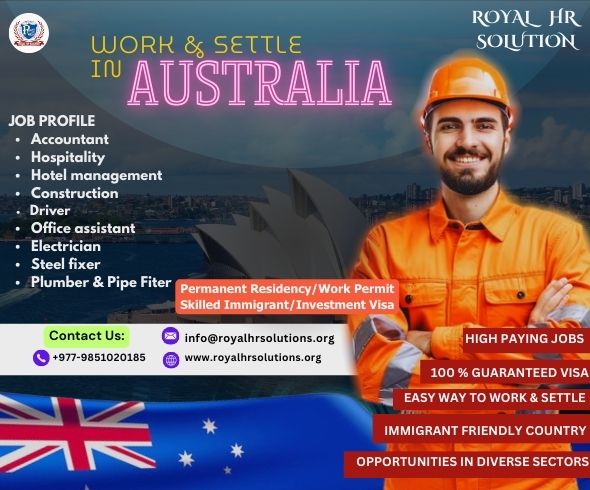
Royal HR Solution, the world’s top overseas immigration consultancy, provides unbiased immigration services for every client based on their interests and requirements.
Our impeccable services of Royal HR Solution include:
can help – fill in your details and we’ll call you back.